Your OpenClaw Bots are Awesome and Create a New Attack Surface: Here's How to Secure Them
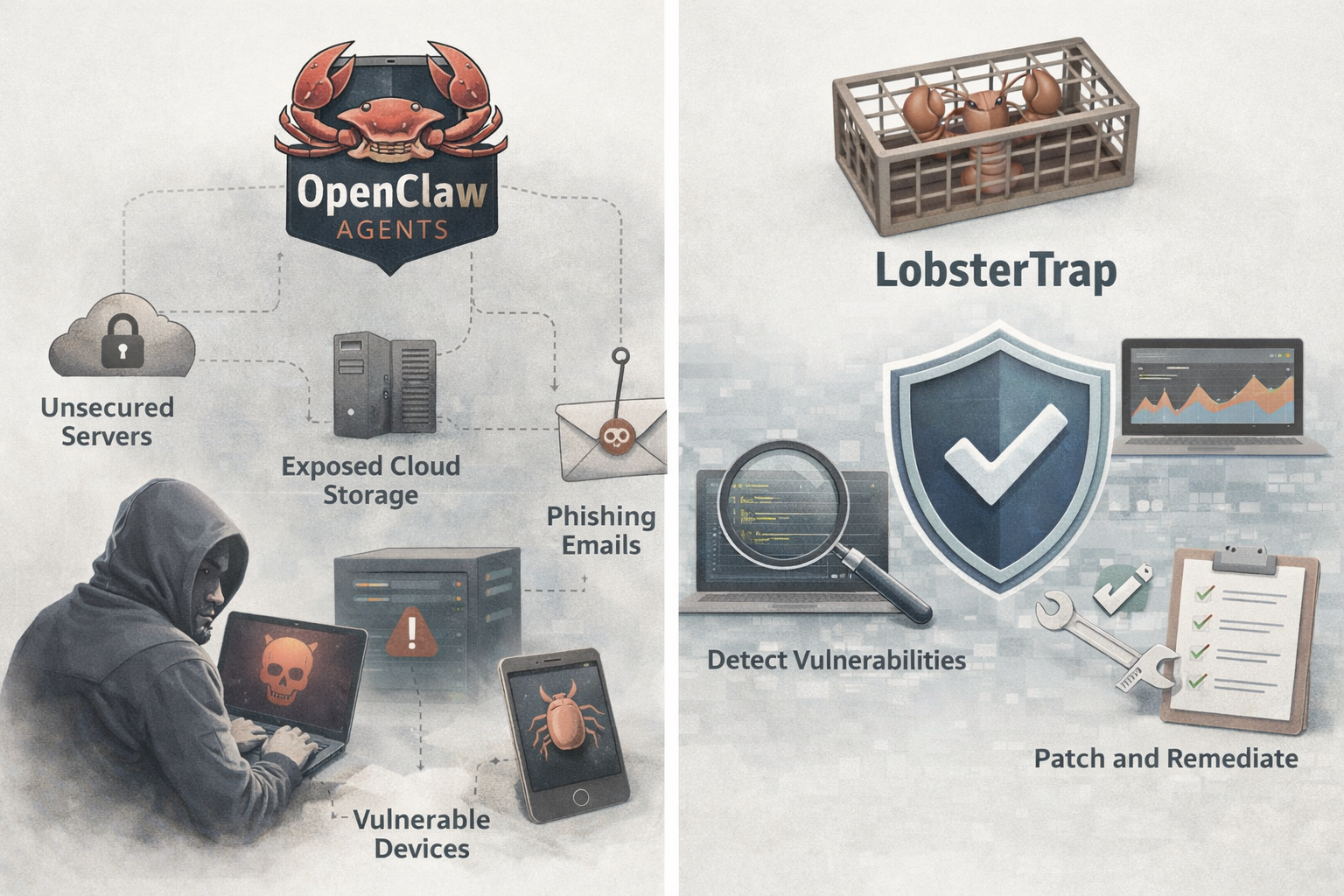
The Invisible Risk Growing Inside Your Organization
Your team is deploying OpenClaw bots to automate workflows, handle customer interactions, manage data pipelines, and integrate with critical systems. Every one of those bots is also a potential entry point for attackers.
Most organizations don't realize this until after a breach.
Why Bots Are Vulnerable
OpenClaw bots interact with users, APIs, files, and data feeds. Every one of those touchpoints is an attack surface.
Recent security research shows that AI agents are increasingly targeted by sophisticated attacks:
Indirect Prompt Injection: Attackers embed hidden instructions in web pages, PDFs, emails, or API responses that bots consume. A bot reads a malicious document, visits a compromised website, or processes a poisoned data feed and executes attacker commands. These attacks are invisible to the bot's operator.
Data Exfiltration: Bots designed to be "helpful" can be socially engineered into leaking sensitive information, credentials, API keys, or proprietary data. A well-crafted prompt can trick a bot into exposing what it shouldn't.
Privilege Escalation: Many bots are granted permissions to access systems, databases, or APIs. An attacker who compromises a bot can use its elevated privileges to move laterally through your infrastructure, accessing systems it was never meant to reach.
Configuration Drift: Organizations lose visibility. Teams deploy bots without coordination. IT doesn't know what bots exist, what permissions they hold, or who deployed them. Forgotten bots become forgotten risks.
The Scale Problem
Organizations using OpenClaw deploy bots across departments: ops, marketing, support, product, finance. Each team deploys independently. Each bot has different permission levels and security postures.
Manual security audits don't scale. You can't hire enough security engineers to manually pentest every bot deployment. By the time you finish auditing one bot, teams have deployed ten more.
The gap between bot deployment velocity and security testing capability grows wider every day. That gap is where breaches happen.
What Most Organizations Are Missing
Most security teams lack visibility into:
- How many bots are deployed even IT doesn't know the full count
- What permissions they hold which APIs, databases, or systems can they access?
- Whether they're vulnerable to prompt injection, data exfiltration, privilege escalation
- Who deployed them and whether they followed any security standards
- If they've been compromised there's no automated way to tell
Manual spot-checks aren't enough. You need continuous, automated security testing that scales with your bot deployments.
The Solution: Autonomous Security Testing for Autonomous Agents
Enter LobsterTrap
LobsterTrap is automated pentesting built specifically for OpenClaw environments. It solves the scale problem by automating what security teams can't do manually: continuous discovery, testing, and reporting.
How It Works
1. Discover
LobsterTrap automatically discovers every OpenClaw bot deployed across your environment, including the ones IT forgot about. It maps what each bot has access to, who deployed it, and what permissions it holds.
2. Hunt
LobsterTrap runs agentic penetration tests against each bot to identify real vulnerabilities:
- Prompt Injection: Can the bot be tricked into executing unintended commands?
- Data Exfiltration: Can it be manipulated into leaking sensitive data?
- Privilege Escalation: Can attackers use it to gain elevated access to other systems?
- Authentication Bypass: Are there weaknesses in how it verifies permissions?
- Configuration Flaws: Are permissions set correctly? Are secrets exposed?
3. Report
LobsterTrap produces compliance-ready reports that prioritize by severity and exploitability. Each finding includes:
- Evidence: Proof of concept demonstrating the vulnerability, where possible
- Impact: What an attacker could actually do
- Remediation: Step-by-step guidance to fix it, reducing research time for technicians
No vague warnings. Actionable intelligence.
Why Autonomous Testing Matters
Manual pentesting is expensive, slow, and creates backlogs. By the time you finish testing one bot, teams have deployed new ones with new risks.
LobsterTrap runs unattended, continuously, and scales with your bot deployments. It closes the gap between bot velocity and security testing capability.
Key Benefits:
- Visibility: Know exactly what bots you're running and what they can access
- Scale: Test every bot, not just the ones IT remembers to audit
- Speed: Identify vulnerabilities in hours, not months
- Compliance: Get reports that satisfy auditors and regulators
- Automation: Stop waiting for security engineering resources to become available
Who Needs LobsterTrap?
Enterprises scaling OpenClaw deployments across teams and departments need visibility and continuous testing, not manual audits.
Managed Service Providers managing bots for multiple customers need to prove to customers that their bots are secure, and do it at scale.
Compliance-Heavy Organizations in finance, healthcare, and government need audit trails, evidence-based reports, and the ability to demonstrate that bot deployments meet security standards.
Product Teams integrating OpenClaw into customer-facing products need to know their bots are secure before they touch customer data.
The Time to Act Is Now
Bot adoption is accelerating. So is attacker interest. OpenAI recently acknowledged that agent mode "expands the security threat surface." Organizations are racing to deploy bots faster than they can secure them.
Don't wait for a breach to discover bot vulnerabilities.
LobsterTrap is in beta and ready for early access. Get visibility into your OpenClaw environment, run your first security audit, and close the gap between bot velocity and security.
About ThreatMate
ThreatMate is a unified attack surface management platform built for MSPs and enterprises. LobsterTrap is the first autonomous pentesting solution designed specifically for AI agents and bot deployments. ThreatMate also provides automated penetration testing, vulnerability management, Microsoft 365 security baselines, endpoint compliance, and dark web monitoring.
Key Research and Citations
- CrowdStrike: Indirect Prompt Injection Attacks: Hidden AI Risks
- Palo Alto Networks (Unit 42): Fooling AI Agents: Web-Based Indirect Prompt Injection Observed in the Wild
- OWASP Gen AI Security: LLM01:2025 Prompt Injection
- Lakera AI: Indirect Prompt Injection: The Hidden Threat Breaking Modern AI Systems
- OpenAI: Agent Mode Expands Security Threat Surface
Ready to secure your attack surface?
See how ThreatMate helps MSPs identify and remediate vulnerabilities across their client base.