Attackers Use AI at Machine Speed. Your Team Still Uses Email. Here's Why That's a Problem
Attackers Use AI at Machine Speed. Your Team Still Uses Email. Here's Why That's a Problem.
The speed gap between AI-powered threat actors and human-dependent defenders is widening. And your team doesn't have the tools to close it.
The Speed Mismatch: Real Numbers
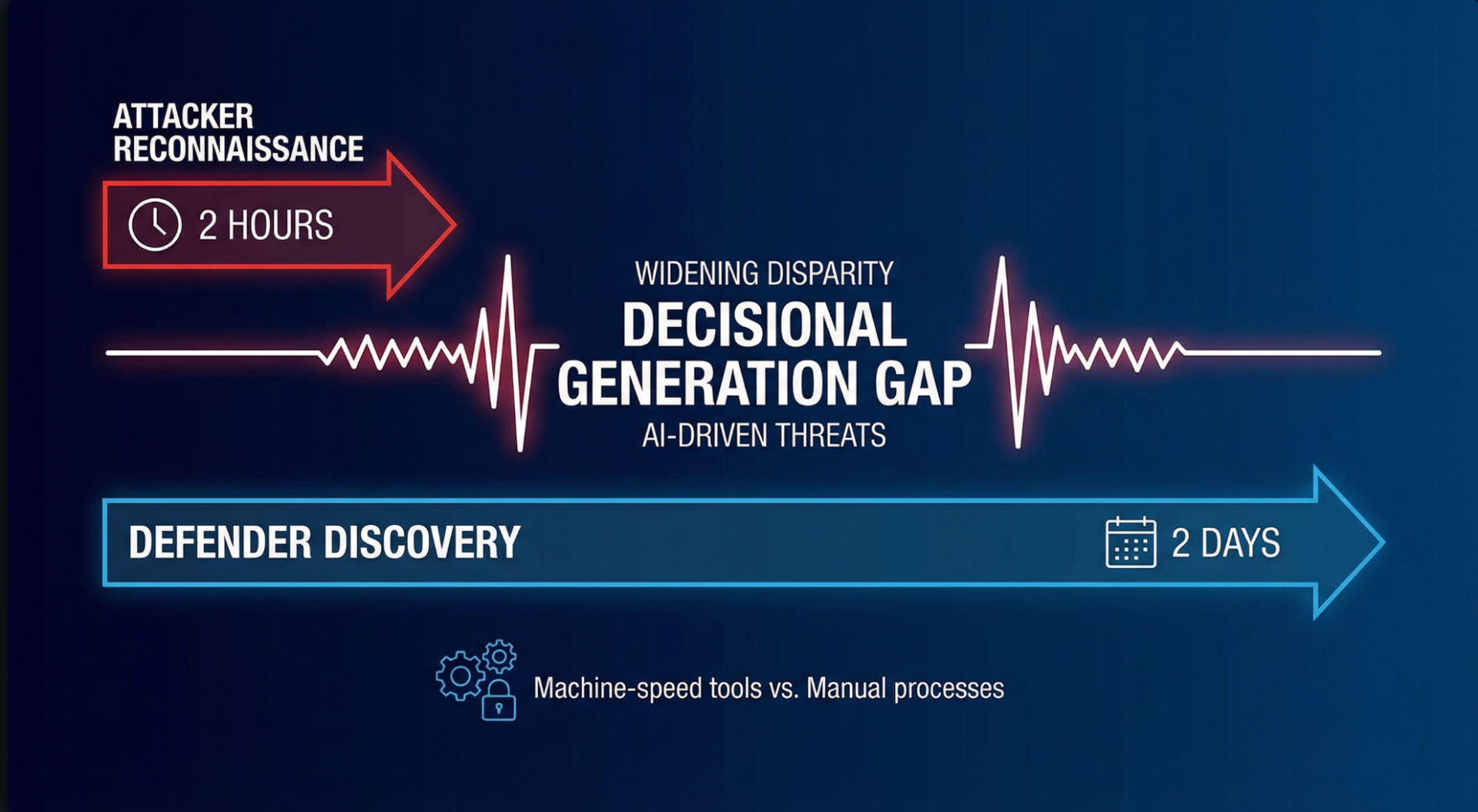
An attacker uses AI to reconnaissance your network. It maps every asset, every user, every vulnerability. It does this in 2 hours.
Your team finds out about it in 2 days.
Meanwhile, that same AI is launching a phishing campaign targeting 500 employees. It's customizing each email based on LinkedIn profiles, company hierarchy, and recent job changes. It's optimizing subject lines in real-time based on open rates.
Your team is forwarding suspicious emails to each other and debating whether it's real.
The attacker uses AI to generate malicious code variants that evade your antivirus.
Your team is manually reviewing alerts in their SIEM, prioritizing by severity, arguing about which ones to escalate.
This is not a hypothetical speed gap. It's the new normal.
New research from Ivanti's 2026 State of Cybersecurity report confirms what every security leader already knows: threat actors are adopting AI faster and deploying it more consistently than defenders. And the consequences are severe.
---
The Speed Mismatch Is Real
Let's be precise about what attackers are using AI for:
Reconnaissance AI enumerates network assets, identifies software versions, catalogs user information. It does in hours what used to take weeks of manual reconnaissance.
Phishing at Scale AI generates personalized phishing emails, optimizes them in real-time, and adapts based on recipient responses. Not just 'Dear Microsoft User'—actual personalization at scale.
Malicious Code Development AI generates exploit code, tests it against antivirus signatures, and produces variants that evade detection. Attackers no longer wait for security researchers to publish CVE exploits; they generate their own faster.
Lateral Movement Once inside, AI identifies lateral movement paths, prioritizes targets, and executes multi-stage intrusions. It's not randomly spraying credentials; it's strategically walking the attack chain.
---
Meanwhile, Defenders Are...
- Collecting telemetry from 47 different tools
- Debating alert fatigue
- Manually correlating findings from vulnerability scanners, endpoint detection, and SIEM data
- Waiting for next week's analyst review meeting
- Creating tickets that get deprioritized
- Responding to incidents in days, not minutes
The gap is not measured in hours. It's measured in decisional generations.
---
Why Your Team Can't Match This Speed
There are three reasons defenders lag attackers:
1. Fragmented Visibility Your team doesn't see a unified picture of the attack surface. They see: - Network vulnerabilities from one scanner - Endpoint detection from another tool - Cloud misconfigurations from a third - M365 attack vectors from a fourth - Dark web credential exposure from a fifth
Each tool generates alerts independently. Correlating them requires human judgment. By the time the correlation is done, the attack has moved to stage three.
2. Decision-Making Bottlenecks Ivanti's research found that 1 in 3 organizations struggle to turn security data into timely decisions. Not because they lack data. Because they lack a process for automated, agentic decision-making.
Your team is drowning in alerts. They're trying to prioritize by severity. They're debating which ones matter. They're creating tickets. They're waiting for approvals. They're scheduling remediation.
Meanwhile, attackers have already moved laterally three times.
3. Manual Remediation Even when vulnerabilities are found, remediation is slow. Your team finds a critical vulnerability. They create a ticket. It goes to a system owner. The system owner schedules a maintenance window. The maintenance window gets postponed. The vulnerability remains open for weeks.
Attackers operate at machine speed. Defenders operate at meeting-scheduling speed.
---
The Real Cost of the Speed Gap
This speed gap has material consequences:
Increased Breach Surface Every minute a vulnerability goes unpatched is a minute an attacker can exploit it. Point-in-time annual pentests leave a 365-day window of vulnerability that attackers can exploit.
Expanded Lateral Movement Slow detection means attackers move further into your infrastructure before defenders even know they're inside. By the time you detect them, they've already exfiltrated data.
Regulatory Exposure Insurance companies and compliance auditors know about this gap. They now require continuous validation, not annual. Organizations that can't provide it face coverage denial.
Reputational Damage When you do get breached, the narrative becomes: 'We knew about this vulnerability but couldn't remediate it fast enough.' That's not a compliance failure; it's a negligence failure.
---
Closing the Speed Gap with Agentic AI
The only way to close a speed gap against machine-speed attackers is with machine-speed defenders.
This means moving from 'automation' (doing the same task faster) to 'agentic AI' (reasoning, adapting, and deciding independently).
Real-Time Adaptation The AI doesn't follow a static playbook. It discovers a vulnerability, assesses whether it's exploitable, chains it with other findings, and pivots based on what it learns. It mimics the reasoning of a human red teamer but operates at machine speed.
Compound Risk Correlation Because the AI has visibility across network + M365 + dark web + endpoints, it can see attack chains that isolated tools miss. A dark web credential becomes an M365 login becomes a file share access becomes a domain admin compromise. The AI sees the narrative of the attack, not just individual vulnerabilities.
Continuous Validation Not once a year. Every week. Every day. The AI is constantly testing, finding new exploitable paths, validating remediations, and updating risk scores. Your clients get a living picture of their actual attack surface, not a static snapshot from last quarter.
Automated Remediation Guidance The AI doesn't just find vulnerabilities; it chains findings to specific remediation actions. It prioritizes by exploitability. It ties each finding to compliance frameworks so you can prove to auditors that you're addressing the right things first.
---
The MSP Case Study: From Slow to Machine Speed
One MSP we work with had the classic speed problem:
- Manual pentesting once per year (365-day exposure window)
- 3 different homegrown vulnerability management tools (fragmented data)
- Average time from detection to remediation: 47 days
- Compliance audits requiring proof of continuous validation: constant headaches
They deployed ThreatMate and shifted to continuous pentesting:
- Weekly automated assessments across network + cloud + dark web
- Single unified Risk Graph (no more tool sprawl)
- Average time from detection to remediation: 6 days
- Automated compliance reporting tied to insurance and audit requirements
The Result They reduced their clients' mean time to response (MTTR) from weeks to days. They moved from 'we test once a year' to 'we validate continuously.' They closed the speed gap.
And they started charging premium pricing for it.
Because their clients finally had what they actually needed: a team (or platform) that moves at the speed of modern threats.
---
Call to Action
Your team will never move faster than attackers using email and spreadsheets. You need agentic AI.
See how ThreatMate enables MSPs to match attacker speed and charge premium pricing for continuous, compound-risk pentesting that actually stops breaches.
Ready to secure your attack surface?
See how ThreatMate helps MSPs identify and remediate vulnerabilities across their client base.