Left of Boom Cybersecurity: An Explainer
What Does "Left of Boom" Cybersecurity Really Mean?
In cybersecurity, "boom" is the moment everything goes wrong.
It's the instant a network is compromised—when an attacker successfully exploits a weakness, gains access, deploys malware, steals credentials, or starts encrypting systems. The boom is not theoretical. It's measurable. And for MSPs and their clients, it's expensive.
Understanding where your security strategy operates on the timeline around that moment is the difference between preventing incidents and managing disasters.
Defining the Timeline: Left vs. Right of Boom
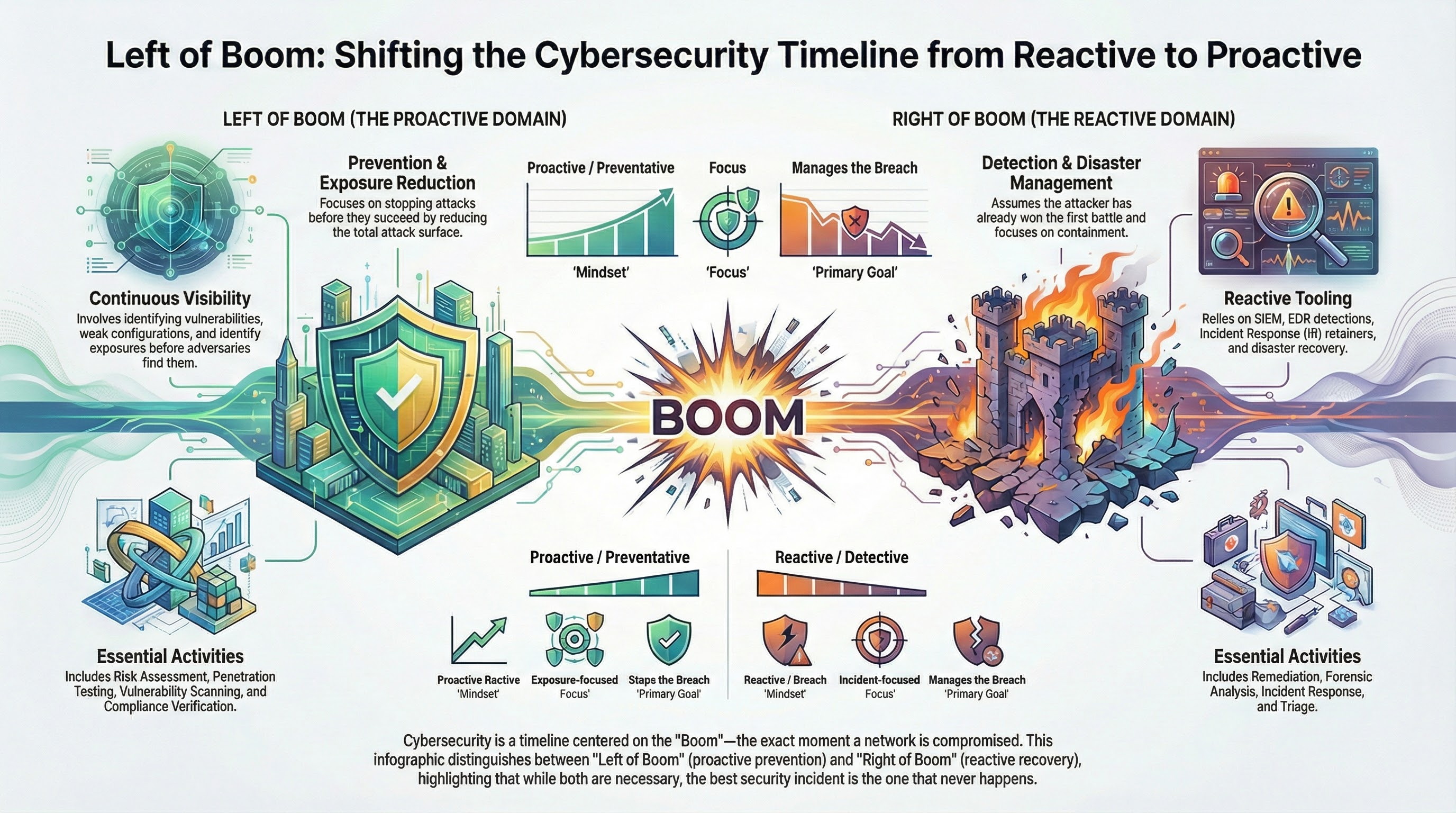
Think of cybersecurity as a timeline with a single critical event in the middle.
The Boom
Boom = successful compromise of a network. An adversary has crossed the line from probing to control.
Left of Boom: Before Compromise
Everything before the boom is Left of Boom.
This is the domain of: - Prevention - Exposure reduction - Attack surface visibility - Risk prioritization
Left of Boom security focuses on stopping the attack from ever succeeding.
Right of Boom: After Compromise
Everything after the boom is Right of Boom.
This includes: - Detection and alerting - Incident response - Containment - Forensics - Recovery and remediation
Right of Boom assumes the attacker already won the first battle.
Why the Industry Talks So Much About Right of Boom
Most traditional cybersecurity tools live on the Right of Boom side: - SIEM - MDR / SOC services - EDR detections - IR retainers - Backup and disaster recovery
These tools are critical—but they are inherently reactive. They exist because compromise already happened or is actively unfolding.
Right of Boom answers the question: "Now that we've been breached, how bad is it—and how fast can we recover?"
That's necessary. But it's not enough.
Why MSPs Live (and Must Win) Left of Boom
Managed Service Providers have a fundamentally different mandate than internal enterprise security teams.
MSPs are paid to prevent problems, not explain them after the fact.
Their core remit is: - Secure client environments - Reduce business risk - Minimize incidents across entire client bases - Do this efficiently, at scale
That makes MSPs inherently Left of Boom operators.
When an MSP does their job well: - Clients don't get ransomware - Accounts don't get taken over - Vulnerabilities don't linger unpatched - Misconfigurations don't become breach headlines
The best security incident is the one that never happens.
What Left of Boom Cybersecurity Actually Looks Like
Left of Boom is not a single tool. It's a mindset backed by continuous visibility.
True Left of Boom security means:
1. Seeing the Entire Attack Surface
Attackers don't care about tool silos. They exploit: - External infrastructure - Internal devices - Cloud misconfigurations - Identity weaknesses - Email and DNS exposures
If you can't see it, you can't secure it.
2. Identifying Security Exposures Before Adversaries Do
This includes: - Known vulnerabilities (CVEs) - Weak configurations - Exposed services - Excessive privileges - Security baseline drift (especially in Microsoft 365)
Attackers automate discovery. Defenders must too.
3. Prioritizing What Actually Matters
Not every vulnerability is urgent. Not every exposure is exploitable.
Left of Boom security focuses on: - Exploitability - Likelihood of attack - Business impact - Real-world adversary behavior
This prevents alert fatigue and wasted effort.
4. Reducing Risk Continuously
Security is not a one-time assessment. It's an ongoing process of: - Finding exposures - Fixing the highest-risk issues - Verifying improvement - Repeating continuously
That's how you stay ahead of attackers who never stop scanning.
Left of Boom vs. Right of Boom: A Simple Comparison
| Left of Boom | Right of Boom |
|---|---|
| Proactive | Reactive |
| Preventative | Detective |
| Exposure-focused | Incident-focused |
| Reduces attack likelihood | Reduces blast radius |
| Scales across clients | Scales response effort |
| Stops breaches | Manages breaches |
ThreatMate's Role in Left of Boom Cybersecurity
ThreatMate was built explicitly for the Left of Boom mission MSPs are responsible for.
The value proposition is simple: Find security exposures across every attack surface—and address them before the adversary does.
That means: - Continuous visibility into internal, external, cloud, and identity attack surfaces - Automated discovery of vulnerabilities and misconfigurations - Risk-based prioritization instead of raw noise - Actionable insight MSPs can operationalize across their client base
ThreatMate doesn't replace Right of Boom tools. It reduces how often you need them.
Why This Matters—Especially Now
Attackers have automated reconnaissance. They scan constantly. They exploit the easiest path first.
The question is no longer if attackers are looking at your clients' environments.
The real question is: Will you find the exposure first—or will they?
That is the difference between operating Left of Boom and living Right of Boom.
And for MSPs, the answer defines trust, retention, and long-term success.
Left of Boom is not a buzzword. It's where real security work happens, before the damage is done.
Ready to secure your attack surface?
See how ThreatMate helps MSPs identify and remediate vulnerabilities across their client base.